Is SEO enough in today’s digital landscape?
Short answer: No❌.
As technology advances, search algorithms are becoming smarter, and user behaviour is rapidly changing.
SEO alone can no longer guarantee visibility or relevance, especially as users increasingly rely on AI-generated answers instead of clicking through to websites.
To stay visible, you must also optimise for GEO, LLMO, and AEO, which complement SEO by helping AI systems understand, rank, and deliver your content.
You might be asking, what GEO, LLMO, and AEO are? Are they just buzzwords? Do they all rely on AI-generated content? Let’s define each term clearly:
Definitions of Acronyms
- SEO (Search Engine Optimisation): Process of getting website traffic without paying for ads.
- GEO (Generative Engine Optimisation): Optimising content so your content can appear in AI-driven search tools.
- LLMO (Large Language Model Optimisation): Process of adjusting your content so large language models (LLMs) can understand and reproduce your information.
- AEO (Answer Engine Optimisation): Optimising content so it can be directly delivered as the answer in voice searches, featured snippets, and AI chat responses.
This article will explore:
- What’s Causing the Increase in Acronyms
- Key Differences Between SEO, GEO, AEO, and LLMO
- Key Elements Shared Across SEO, GEO, LLMO, and AEO
- The Risks of Ignoring GEO, LLMO, and AEO
- 3 Phase SEO, GEO, LLMO, and AEO Action Plan
- SEO, GEO, LLMO, and AEO, which do I need?
- A list of frequently asked questions (FAQs) about SEO, GEO, LLMO, and AEO
And if you’re running out of time, here’s the TL;DR summary for you:
SEO alone is no longer enough to stay visible in today’s AI-powered search world.
To stay competitive, you need to optimise for GEO, LLMO, and AEO alongside SEO:
- SEO (Search Engine Optimisation): Helps your website rank on search engines.
- GEO (Generative Engine Optimisation): Makes your content appear in AI-generated search results.
- LLMO (Large Language Model Optimisation): Ensures AI tools like ChatGPT or Gemini can understand and accurately reuse your content.
- AEO (Answer Engine Optimisation): Optimises for direct answers in AI chats, featured snippets, and voice searches.
Together, these form the foundation of AI SEO and can boost your visibility across Google, AI platforms, and voice search.
Focus on E-E-A-T (Experience, Expertise, Authoritativeness, and Trustworthiness), structured content, natural language, and regular updates to help both people and AI understand, trust, and recommend your content
What’s Causing the Increase in Acronyms
Have you ever wondered why there are many new acronyms suddenly appeared in the digital landscape?
Here are the key reasons behind this rapid rise:
1. Standing Out from Competitors
Acronyms create a sense of uniqueness or exclusivity. Marketers introduce new acronyms like “GEO”, “LLMO”, and “AEO” to let them stand out from competitors. This is “basic marketing psychology” as the distinct sound of acronyms can grab attention and help a brand differentiate itself in a crowded market.
2. Adapting to AI
With more people getting answers directly from AI tools, website traffic is dropping. To stay relevant, marketers introduce new acronyms to show that they are adapting to the changing landscape and position themselves as knowledgeable and up-to-date.
3. Simplifying Complex Concepts
Acronyms provide users a quick way to understand complex and fast-changing concepts. For instance, mentioning “SEO” immediately conveys search engine optimization without a long explanation, making information easier to grasp and act on.
Grow Your Traffic and Increase Your Revenue
Get started to drive your revenue from organic search with us today.

Key Differences Between SEO, GEO, AEO, and LLMO
SEO, GEO, AEO, and LLMO aim to increase visibility, but the way to achieve it is different:
| Aspect | SEO | GEO | LLMO | AEO |
|---|---|---|---|---|
| Goal | Website can be rank on the first page of the search results | Content can be cited or referenced by AI search engines within AI-generated summaries | Content can be understand and retrievable by large language models | Content can be chosen by AI-powered platforms as direct, concise answers to user queries |
| Focus | Keywords, internal links, backlinks, technical performance, and on-page optimisation | Authoritative language, accurate, updated and structured content, headings, and citations | Recognise relationships, combine multiple and accurate, updated, and structured content | Conversational language, FAQs, and precise answers |
| Content Style | Content around the keyword only | Structured for Extraction, Factual and Authoritative, Comprehensive but Digestible, Focus on Clarity and Consistency | Conversational Tone, Question-Friendly Format, Semantic Richness and Context, Optimised for Interpretation | Short, direct answer in Q&A style |
| Interaction Style | User search for information, click your site in SERPs, and then visit your page | User interacts with AI chat or generative search outputs | AI references or summarises your content inside responses | User receives direct answers (spoken or displayed) |
| Where it shows | SERPs | AI chat response (ChatGPT, Copilot, etc), and Google AI Overviews | LLMs platform (ChatGPT, Claude, Gemini, etc) | Voice Searches (Siri, Google Assistant, etc), Featured Snippets, and AI chat responses (ChatGPT, Copilot, etc) |
| How it works | Uses algorithms to index, rank, and display web content based on relevance and authority. | AI models evaluate trustworthy, structured sources to generate or cite answers. | LLMs learn from your published and high-authority content to inform their responses. | LLMs learn from your published and high-authority content to inform their responses. |
Key takeaway💡: SEO, GEO, LLMO, and AEO collectively form the foundation of AI SEO. Each contributes to visibility across different digital ecosystems.
To perform well, your content should demonstrate E-E-A-T (Experience, Expertise, Authoritativeness, and Trustworthiness) and be clear, structured, and credible.
When optimised effectively, AI systems can cite or reference your content, increasing visibility and potential traffic.
Key Elements Shared Across SEO, GEO, LLMO, and AEO
If you still don’t understand these acronyms, that’s completely fine. There are several key elements to help your company stand out, whether you are optimizing for SEO, GEO, LLMO, or AEO. These elements work together to increase visibility and credibility by ensuring your content is easily understood, trusted, and cited by both humans and AI systems.
Below are the common elements among them:
1. Authority-Driven Content
To rank higher or be cited by AI systems, your content must demonstrate E-E-A-T (Experience, Expertise, Authoritativeness, and Trustworthiness). This is because Large Language Models (LLMs) and search algorithms prioritise sources that show clear expertise and reliability.
You can achieve this by:
- Citing credible sources
- Highlighting expert opinions or credentials
- Producing original, experience-based insights
- Maintaining consistent brand authority across all content
2. Structure Content
Structured content is easier for AI systems and search engines to understand, making your content more likely to be recognised and cited.
To achieve this, organise your content with:
- Clear headings and subheadings (H1, H2, H3, etc.)
- Bullet points and numbered lists for clarity
- Structured data and schema markup to help search engines interpret meaning and context
- Tables and visuals to make information scannable
AI systems process information similarly to how humans read. Concise and well-organised explanations that can be understood within seconds. Therefore, keep your content clear, direct, and logically structured to improve both user experience and AI visibility.
3. FAQs section
Identify the exact questions your audience might ask in search engines or AI tools (e.g., “How do I…?” or “What is…?”). Once you know these questions, craft clear, concise, and helpful answers.
Benefits of an FAQs section include:
- Helping users find answers quickly
- Allowing search engines and AI systems to easily detect and display your content in featured snippets or AI-generated answers
- Improving engagement and authority by directly addressing user concerns
In short, FAQs make your content more user-friendly, AI-friendly, and search-friendly by delivering precise answers that add genuine value.
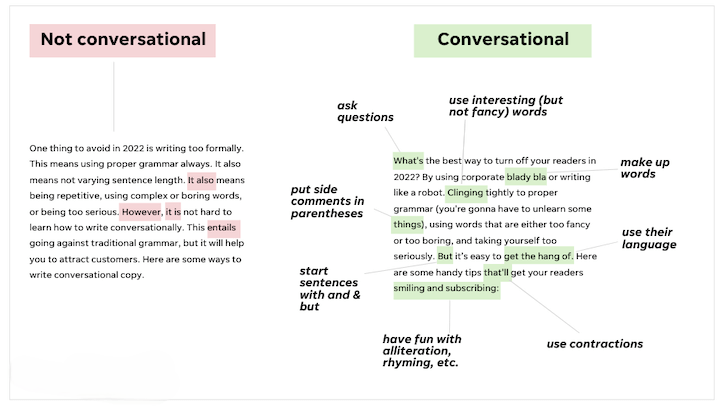
4. Conversational and Natural Language
Search engines and AI systems prefer content that sounds natural and conversational. This means writing as you are explaining to a person, not producing overly technical or keyword-stuffed text.
5. Website Performance
The speed of your website play important roles in how search engines and AI systems evaluate your content. A fast, well-optimised site provides a better user experience and increases the likelihood of your content being ranked or cited.
Ways to improve website performance:
- Compress images
- Minifying CSS and JavaScript
- Use a Content Delivery Network (CDN)
The Risks of Ignoring GEO, LLMO, and AEO
As technology advances, GEO, LLMO, and AEO become critical for online visibility. Many companies are now employing strategies such as GEO, LLMO, and AEO, rather than relying solely on SEO.
Ignoring any of these can cause your content to be overlooked or even disappear from search engines and AI-driven platforms.
Below are the key risks:
1. Loss of visibility
Ignoring GEO, LLMO, and AEO can prevent AI systems from recognizing your content as relevant. Therefore, your content may not appear on AI systems. Meaning that users have fewer opportunities to discover your content, which can lead to a significant drop in visibility.
2. Loss of the competitive advantages
Ignoring GEO, LLMO, and AEO can cause your website to fall behind competitors. As more users rely on AI assistants and chatbots instead of traditional search engines, competitors who focus on GEO, LLMO and AEO are more likely to be featured in the AI system. This means your website could lose traffic, even though the ranking on the traditional search engine is high.
Want to improve your ROI?
Get more qualified traffic on the search terms that matter most to your business today!
3 Phase SEO, GEO, LLMO, and AEO Action Plan
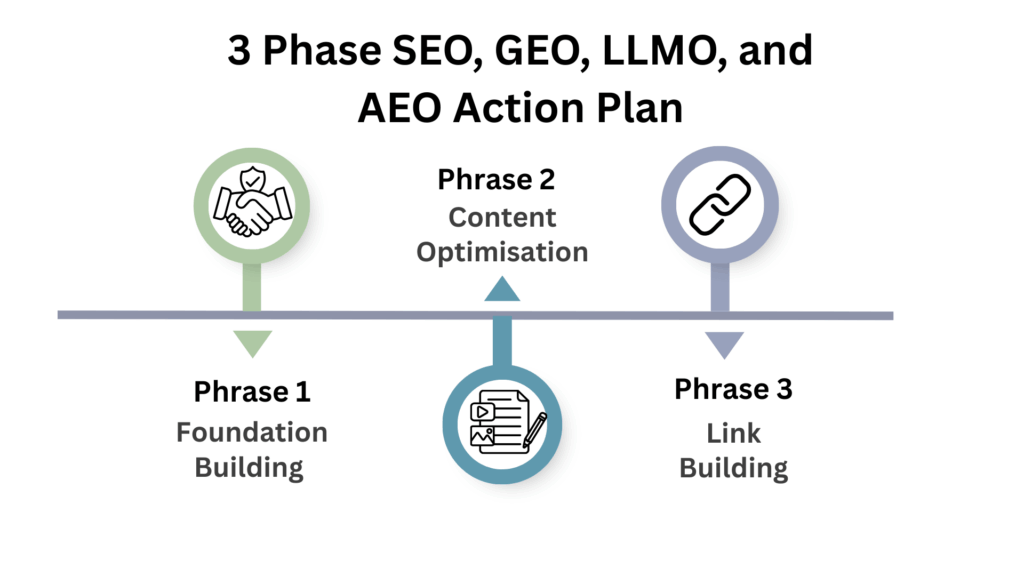
Before implementing SEO, GEO, LLMO, or AEO, you must understand each phase to ensure the process is smooth and effective.
Below are the three phases you can follow:
Phrase 1: Foundation Building
Create the authoritative, reliable, and structured content to show your business expertise. Your content must clearly explain your products, services, or how-to processes using easy-to-read formats like bullet points, tables, and FAQs. Adding schema markup (like FAQPage or HowTo schema) can help AI interpret your page’s meaning.
Phrase 2: Content Optimisation
Get your brand mentioned or linked from trusted third-party sites through guest articles, press coverage, or original research. AI systems value content that’s backed by reputable external sources. This can show AI that your brand is trusted by others rather than self-promoting.
Phrase 3: Link Building
Get your brand mentioned or linked from trusted third-party sites through guest articles, press coverage, or original research. AI systems value content that’s backed by reputable external sources. Therefore, understanding how to build external links effectively is essential, as it helps demonstrate to AI that your brand is trusted by others rather than self-promoting.
SEO, GEO, LLMO, and AEO, which do I need?
All four serve different but complementary purposes:
- SEO ensures your website can appear in SERP.
- GEO ensures your content is referenced or cited in AI-generated search results.
- LLMO improves how AI systems understand and reuse your information when generating answers.
- AEO helps your content appear as direct answers (ideal for FAQs, voice searches, and snippets).
In most modern strategies, you don’t choose just one. You integrate all four to future-proof your visibility across both traditional and AI-driven platforms.
Grow Your Traffic and Increase Your Revenue
Get started to drive your revenue from organic search with us today.
Conclusion
The rise of new acronyms like GEO, LLMO, and AEO simply reflects the changing digital landscape. To stay visible, you shouldn’t rely on SEO alone. Combining SEO with GEO, LLMO, and AEO helps keep your content relevant on both search engines and AI systems. Instead of stressing over every new acronym, focus on creating clear, helpful, and reliable content.
It is not easy to conduct AI SEO! If you have any concerns, contact VeecoTech today for a personalised consultation.
FAQs
1. Will GEO, LLMO, and AEO replace SEO?
No. GEO, LLMO, and AEO will not replace SEO, but SEO will grow and adapt to include AI. SEO focuses on search rankings to make the website rank on the first page of the search results, while GEO, LLMO, and AEO include the AI that allows users can get the answer quickly.
2. Will AI reduce my traffic?
AI may change how users find and consume your content, but it doesn’t necessarily mean less traffic. While some users now get answers directly from AI tools like ChatGPT or Google AI Overviews, there are still strong opportunities for visibility. If your content is clear, helpful, and easy for AI systems to understand, it can still appear as a source, citation, or summary in those AI answers. That means people might discover your brand in new ways, even if they don’t click straight from Google.
3. How can I make my content easier to detect by AI?
Use a clear structure with headings, bullet points, or tables. Add structured data (like schema), write in natural and simple language, show your expertise, and keep your content accurate and updated.
4. SEO, GEO, AEO or LLMO, which is more important?
All are important and work together. SEO builds visibility, GEO targets AI search, LLMO improves AI understanding, and AEO helps your content appear as direct answers.
5. Do I need to hire an AI SEO specialist for GEO, LLMO, and AEO?
Not necessarily, but implementing without basic knowledge could be difficult. And, we provide consultancy services to help you.